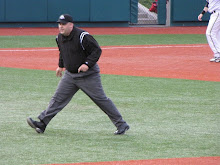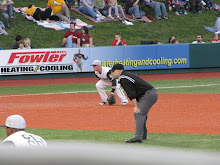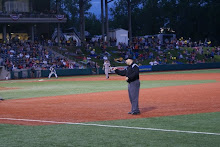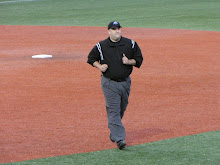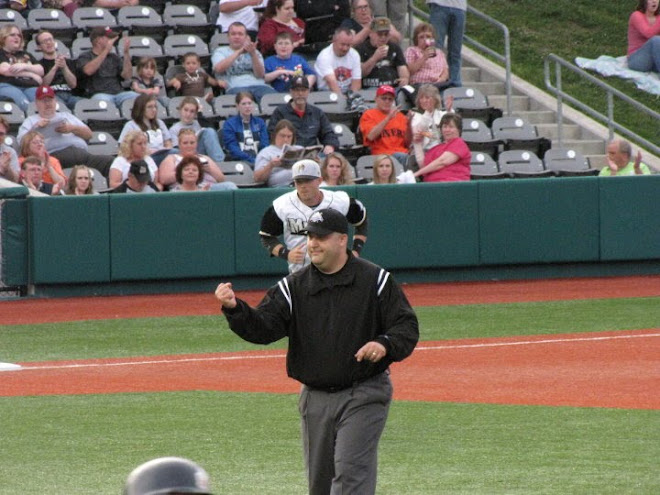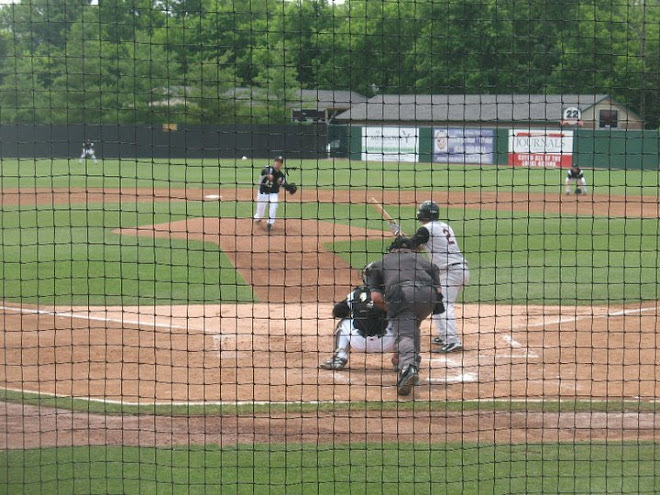
I was training the other day and I asked a group of 14 year old rookies, what the responsibilities of the plate umpire were. They all gave me pretty much the same answer, to call balls and strikes and to make calls on plays at the plate. Both are correct answers but there is a lot more into being a good plate umpire besides these. This post is going to go through what I determine to be the responsibilities of the plate umpire:
1) First and foremost, calling balls and strikes is the most important task an umpire does. It is also what separates the decent umpires from the good umpires. One of these days, I am going to put up a video on mechanics behind the plate but for the purposes of this post, know this: the key to being good at calling balls and strikes are simple. You need to be consistent. The strike zone does not change during the game, no matter what the score it. You need to be loud. The deaf grandmother needs to be able to hear your strike call. And you need to have good timing. PAUSE, READ, REACT!! See the pitch, think the call, make the call.
2) Fair and Foul Decisions. When you get older and start working with more experienced umpires, this gets more complicated but as a younger umpire in our system, the plate umpire takes ALL fair/foul decisions. So you have to be ready to get on that line and make the call.
3) Fly balls to the outfield. In our system, with no runners on base, the plate umpire takes takes all fly balls. Even though you can do that from behind the plate, it makes you look A LOT better to get out from behind the plate and get a better view of the play. Sometimes you only have to take 5 steps, other times (i.e. sinking line drive that the left fielder might dive for) you need to get past the pitching mound. The key is to just get out from behind the plate and hustle.
Now, if there is are runners on, this is where it gets complicated. If the ball is hit from inbetween the left fielder and the right field (or other words, there is no chance it is going to be a foul ball) then the field umpire takes the ball and the plate umpire makes sure the runners touch the bases. In this situation, you won't go to far from the plate because you might have a play at the plate. If the fly ball is hit down the line, the plate umpire takes the ball and the field umpire watches the runner. CONFUSED YET?
4) BALKS!!!! This is technically both umpires responsibilities but it is important.
5) Ground Balls with no runners on - On ground balls with no runners on, the plate umpire needs to clear the catcher and follow the runner down the first base line about 10 to 12 steps. (Half way down the line if you want to do it like the pros but it's not necessary). You do this for two reasons. First, sometimes your partner misses the fielder pulling his foot early, you are another set of eyes that can be used, IF HE ASKS FOR HELP. Remember, you NEVER overturn a partners call. If he wants help, he will ask and then you can tell him what you say. It is up to the partner if they want to change the call or not. The second reason you head down the line is to make sure the runner stays in the running lane.
As you umpire more, you will learn of more responsibilities but for the younger umpire, this will be more than enough to think about as you start working this spring. Just remember, the umpire that hustles is less likely to get yelled at as the umpire who just stands in one spot all game.
Have fun this summer and PLAY BALL!!!
Showing posts with label Youth Baseball. Show all posts
Showing posts with label Youth Baseball. Show all posts
Tuesday, March 20, 2012

Wednesday, February 15, 2012
Rules question
In our training session tonight this question came up.
Runner on 3rd. Batter hits a routine pop up to the third basemen that hits the runner on third while he is standing on the base. What's the call??!
Runner on 3rd. Batter hits a routine pop up to the third basemen that hits the runner on third while he is standing on the base. What's the call??!
Thursday, September 29, 2011
Quick Tip for the Young Umpire
There are times as an umpire when a coach, player or fan can get you so upset that you actually just want to start screaming at them. Hell, there have been times that I have wanted to haul off and knock their teeth right down their throat. But as an official you need to learn how to rise above that.
When I was 16, I had a game where a coach put his hands on me. It was just a small shove but he still put his hands on me. Every instinct I had told me to shove him back but my partner had grabbed me and told me to walk away. Later, I was talking to my Dad and he told me that it is always best to kill them with kindness. As I have matured as an umpire, I have always rememebered that.
If you ever watch me umpire, I call everyone sir (even 12 year old players). I call the mom's Ma'am if they ask a question. If a coach starts an argument, I still call them sir. If we get into a screaming match with one another, I still call him sir. I know that there are times I am going to have to yell but I always try to be professional.
That is one tip I try to give every young umpire I work with. Sure there are times you are going to have to lay the law down when working a game but never ever lose your professionalism.
When I was 16, I had a game where a coach put his hands on me. It was just a small shove but he still put his hands on me. Every instinct I had told me to shove him back but my partner had grabbed me and told me to walk away. Later, I was talking to my Dad and he told me that it is always best to kill them with kindness. As I have matured as an umpire, I have always rememebered that.
If you ever watch me umpire, I call everyone sir (even 12 year old players). I call the mom's Ma'am if they ask a question. If a coach starts an argument, I still call them sir. If we get into a screaming match with one another, I still call him sir. I know that there are times I am going to have to yell but I always try to be professional.
That is one tip I try to give every young umpire I work with. Sure there are times you are going to have to lay the law down when working a game but never ever lose your professionalism.
Tuesday, September 20, 2011
Where has the fun gone?
Excuse for a minute while I pull out my soap box because I have something to get off my chest. When did little league baseball stop being fun? This past summer I have really noticed that it doesn't seem like the coaches, kids, fans or umpires are having nearly as much fun as they used to.
The other night I was umpiring a boys 12 fall ball game. It was between two fairly good teams. One team had a coach who didn't say one good thing the entire night. There was no constructive criticism. There was just yelling!! If I was a parent of a kid on this team, I would have pulled my kid off the field. At one point, a kid hit a screaming line drive to the center fielder. He crushed it but he hit it right at him. The coach started yelling at the kid for not getting around on the ball quicker. Really? Are you kidding me? What happened to a pat on the butt and telling the kid "Nice stroke, keep your head up."
I don't understand when the mentality of little league baseball change. When I was a kid, I played National Blue which was as high as you could play in our league. We were a pretty good team. We took it seriously. We wanted to win. But it was fun. Our coaches understood that it was their jobs to teach us the fundamentals of the game and get us ready for high school. Winning was nice but it wasn't the most important thing. Sure, if we didn't have our heads in a game, we would get yelled at but it wasn't nearly as brutal as it is today.
As an outsider looking in, I am nervous about my son playing baseball when he is old enough. I am all for tough love but the coaches today are so focsued on winning they forget that their main job is the fundamentals. Not to teach a 10 year old to throw a curve ball. And even though there is a time a place for coaches to yell, there is no place where are kid should be asked if he is stupid for making a mistake.
As an umpire, I have to remind myself at times there as long as the coaches don't physically harm the players there is nothing I can do. If the parents want to put their children in that type of situation, who am I to say anything about it. But I will tell you that I have been around little league baseball for my entire life. Kids are not having as much fun as they used to. Sure, I think the kids still like the game but not with the same zeal we did when I played as a kid.
When I get to the point where my son starts playing baseball, I am going to coach. Not because I think I know the most about the game. I don't. But I can teach the fundamentals as well as anyone and I really think that, and having fun, are the most important aspects to little league baseball.
Friday, June 24, 2011
You make the call
This happened the other night in a game I was working. Let's see how you would have ruled.
Runner on first. The pitcher comes set and the runner leaves early. Without stepping off, the pitcher spins and throws to second to make the play on the runner. Is this a balk for throwing to an unoccupied base?
You make the call.
Runner on first. The pitcher comes set and the runner leaves early. Without stepping off, the pitcher spins and throws to second to make the play on the runner. Is this a balk for throwing to an unoccupied base?
You make the call.
Thursday, June 2, 2011
Rule Question
I'm sure most of you will know this but I'm tired today and this is all I can come up with.
Runners on first and second. The runner on first gets his signs mixed up and steals. The runner on 2nd does not. They both end of standing on the base. The fielder, tags both of them while they are both standing on the base. Who's out?
Runners on first and second. The runner on first gets his signs mixed up and steals. The runner on 2nd does not. They both end of standing on the base. The fielder, tags both of them while they are both standing on the base. Who's out?
Thursday, May 26, 2011
Rules Question
This happened to me about 9 years ago and it came up in a discussion the other day. Let's see if you know the answer.
Runner on first. Runner steals on the pitch, the catcher goes to throw him on and hit's the plate umpire on the backswing of his throw which causes him the throw the ball into center field. The runner ends up on third. What's the call?
Runner on first. Runner steals on the pitch, the catcher goes to throw him on and hit's the plate umpire on the backswing of his throw which causes him the throw the ball into center field. The runner ends up on third. What's the call?
Tuesday, May 24, 2011
Code of Conduct for Umpires
In my last post, I recieved the following comment:
"just had an umpire yell at a 14 yr old kid, 2 inches from his face like he was going to beat him up because he drew a line with the bat to connect part of the batters box that was scrubbed away. is there a conduct rule for umpires in Little League?"
Here is my response:
I believe that in little league and in all levels of baseball there is a definite code of conduct for umpires. Umpires need to be professional at all times. Sure there is a time to yell and show that you are in control of the field but even then, you do it respectively and stay in control. When I get into an argument with a coach, no matter what he says to me, I still call him sir. If a kid gets on me, I might go talk to coach or say something to the kid but I stay in control. I don’t lose my cool. As an umpire, you are a representative of your league, your complex and every umpire that works with you.
Getting in a 14 year olds face is not acceptable. There is nothing that a kid could do that would make me do something like that. The way I look at it, if the offense warrants getting in the kids face, then he should be thrown out of the game anyways so I would just do that. I have two ways of handling a situation with a player. The first is that I pull the kids aside and calmly talk to him and explain that I’m not going to put up with it. Or I talk to the coach and let him deal with it. The only time I might really raise my voice at a player is if he argues balls and strikes but even then, it’s something simple like knock it off or that’s enough. I never get in a players face. Actually, I think in my 22 years, I have only been in three arguments at the little league level where I was in someone’s face and in each situation, the coach was the one getting in my face.
Hope that answers your question.
"just had an umpire yell at a 14 yr old kid, 2 inches from his face like he was going to beat him up because he drew a line with the bat to connect part of the batters box that was scrubbed away. is there a conduct rule for umpires in Little League?"
Here is my response:
I believe that in little league and in all levels of baseball there is a definite code of conduct for umpires. Umpires need to be professional at all times. Sure there is a time to yell and show that you are in control of the field but even then, you do it respectively and stay in control. When I get into an argument with a coach, no matter what he says to me, I still call him sir. If a kid gets on me, I might go talk to coach or say something to the kid but I stay in control. I don’t lose my cool. As an umpire, you are a representative of your league, your complex and every umpire that works with you.
Getting in a 14 year olds face is not acceptable. There is nothing that a kid could do that would make me do something like that. The way I look at it, if the offense warrants getting in the kids face, then he should be thrown out of the game anyways so I would just do that. I have two ways of handling a situation with a player. The first is that I pull the kids aside and calmly talk to him and explain that I’m not going to put up with it. Or I talk to the coach and let him deal with it. The only time I might really raise my voice at a player is if he argues balls and strikes but even then, it’s something simple like knock it off or that’s enough. I never get in a players face. Actually, I think in my 22 years, I have only been in three arguments at the little league level where I was in someone’s face and in each situation, the coach was the one getting in my face.
Hope that answers your question.
Thursday, May 19, 2011
Where's the Respect Part 2
This season has been a pretty decent season. I have had a chance to umpire some really good baseball but I have to tell you, I am getting to the point where this isn't fun anymore. The lack of respect towards umpires by coaches, fans and players is amazing. This was stuff that didn't happen 6-7 years ago, let alone when I played.
I'm an umpire. Arguments are part of my job. I understand that they are going to happen. I know I am going to tick some people off and they are going to get in my face from time to time...I'm ok with that. What I am not ok with is the blantent lack of respect for us. I will give you a couple examples. The other night at my complex, a mom followed one of the umpires to his car after the game screaming at him the entire time. I had a kid turn around a tell me I was crazy on a strike three call a week ago. Two nights ago on a play where a kid tagged a player with his glove while he was holding the ball in his throwing hand, a kid threw his glove in the air and yelled, "you have got to be kidding me" Now, I am one who doesn't like to throw players (or anybody to be completely honest with you) out of games. But it has gotten to the point that starting tonight, I am going to warn all the players before the game that this won't be tollerated.
You know, I am making it sound like I work at the worst ballpark in America. I can tell you that I have seen in everywhere. I was in Chicago a few weeks ago and 11 year old kids were yelling at the umpire on the visiting team. A scorekeeper cussed out the umpire after the game. At the fields near my house, I stopped by to talk to someone and I saw three fans ejected from the park in a matter of 10 mintues on three different fields. This is something that has to stop.
I think the problem is that people are forgetting that little league baseball is about getting the kids ready to play high school baseball and to have fun...that's it. It's not about how many games you win, it's not about playing in tournaments all over the country. WHile that stuff is fun, it's not the most important thing and I think that has been lost with parents and it is carrying over to the players.
Anyways, I figure I can get off my soapbox now. Weather permitting, I have two tonight. Hopefully, they are event free.
I'm an umpire. Arguments are part of my job. I understand that they are going to happen. I know I am going to tick some people off and they are going to get in my face from time to time...I'm ok with that. What I am not ok with is the blantent lack of respect for us. I will give you a couple examples. The other night at my complex, a mom followed one of the umpires to his car after the game screaming at him the entire time. I had a kid turn around a tell me I was crazy on a strike three call a week ago. Two nights ago on a play where a kid tagged a player with his glove while he was holding the ball in his throwing hand, a kid threw his glove in the air and yelled, "you have got to be kidding me" Now, I am one who doesn't like to throw players (or anybody to be completely honest with you) out of games. But it has gotten to the point that starting tonight, I am going to warn all the players before the game that this won't be tollerated.
You know, I am making it sound like I work at the worst ballpark in America. I can tell you that I have seen in everywhere. I was in Chicago a few weeks ago and 11 year old kids were yelling at the umpire on the visiting team. A scorekeeper cussed out the umpire after the game. At the fields near my house, I stopped by to talk to someone and I saw three fans ejected from the park in a matter of 10 mintues on three different fields. This is something that has to stop.
I think the problem is that people are forgetting that little league baseball is about getting the kids ready to play high school baseball and to have fun...that's it. It's not about how many games you win, it's not about playing in tournaments all over the country. WHile that stuff is fun, it's not the most important thing and I think that has been lost with parents and it is carrying over to the players.
Anyways, I figure I can get off my soapbox now. Weather permitting, I have two tonight. Hopefully, they are event free.
Thursday, May 12, 2011
Rules Question
I had this come up the other day. Let's see how you would rule it.
Runners on 1st and 2nd, one out. The pitcher steps off the rubber and throws the ball to first in an attempt to pick off the runner. THe ball goes over the first basemens head and goes out of play. Where to the runners go?
Runners on 1st and 2nd, one out. The pitcher steps off the rubber and throws the ball to first in an attempt to pick off the runner. THe ball goes over the first basemens head and goes out of play. Where to the runners go?
Tuesday, May 10, 2011
Rules Question
Runners on 1st and 2nd, 1 out. The batter hits a fly ball to deep right field. Runners on 2nd and 3rd tag up and move up one base. The ball goes back to the pitcher who steps on the rubber and then steps off and appeals the runner leaving early at second. The umpire calls the runner out of leaving early for the third out. Does the run score?
Friday, April 15, 2011
Two Games on a Perfect Night
There are some night when being at the ballpark is an absolute joy...last night was one of those nights. The weathers was perfect, the games (even though not all that competative in the first game) moved along quickly and there were no problems to speak of.
Last night I had two boys 13 games. I had the plate duties for the first game and it was the perfect type of game to have behind the plate. The pitchers were around the plate, the batters swung the bats and we were done in an hour 20 minutes. I love it when you have don't have to rush to get ready for your second game. The game itself wasn't that exciting. The final score was 14-4 and it could have been a lot worse. I did get a chance to umpire a couple kids who played on the soccer team I coached last fall so that was fun.
The second game was another boys 13 game. This was a pretty good game. The pitchers did a great job of staying around the plate in this game. I had three or four close plays in the field to keep me awake. We had three infield flies and a few balks but once again, there really were any situations that came up. We did have another balk call where the kid actually hit the ball. This time it was caught by the left fielder so we enforced the balk. The funny thing was, the coach came out about 3 batters later to ask why we enforced the balk. It was pretty funny.
It was honestly a very easy night at the ballfields last night. Now that I have said that, I'm sure next Tuesday will be a difficult night but that's ok...sometimes those nights can be fun too.
Last night I had two boys 13 games. I had the plate duties for the first game and it was the perfect type of game to have behind the plate. The pitchers were around the plate, the batters swung the bats and we were done in an hour 20 minutes. I love it when you have don't have to rush to get ready for your second game. The game itself wasn't that exciting. The final score was 14-4 and it could have been a lot worse. I did get a chance to umpire a couple kids who played on the soccer team I coached last fall so that was fun.
The second game was another boys 13 game. This was a pretty good game. The pitchers did a great job of staying around the plate in this game. I had three or four close plays in the field to keep me awake. We had three infield flies and a few balks but once again, there really were any situations that came up. We did have another balk call where the kid actually hit the ball. This time it was caught by the left fielder so we enforced the balk. The funny thing was, the coach came out about 3 batters later to ask why we enforced the balk. It was pretty funny.
It was honestly a very easy night at the ballfields last night. Now that I have said that, I'm sure next Tuesday will be a difficult night but that's ok...sometimes those nights can be fun too.
Wednesday, April 13, 2011
Two Games, Two Ejections
There was a time in my umpiring career (I use that term loosely) that I really enjoyed getting into arguments and throwing people out of games. As I have gotten older, I have felt that if I had to throw somebody out, I wasn't doing my job correctly. That isn't always that case but in my mind, it is. It had been over two years since I had thrown anybody out of a little league game but last night that changed.
The first game was a Boys 11 select Gold (Top Division) game between two really good teams. I was behind the plate and I was working with another experienced umpire (I thought it was a younger umpire but I was mistaken). My game behind the plate was the best game I have called all year. The kids were around the strike zone and the batters wanted to swing the bat. My field umpire had a few tough calls but there were two at third that really got the coaches on the losing team upset. Now, I have no idea if he got the calls right or not. Both were tag plays and on both of them, the ball beat the kid to the base by a mile. However, the tag was behind the fielder so I was blocked and couldn't see it. Both calls were safe.
On the first one, the coaches started yelling but calmed down almost instantly. On the second one, the game was tied and their team was starting to fall apart. When this safe call was made, four coaches came flying out of the dugout to argue. The head coach to his credit, told them to sit down. Then the scorekeeper (another coach on this team) started screaming his head off. He was out of the dugout and just going nuts. I told him to calm down but he didn't hear me so I yelled pretty loudly for him to stop and sit down. He went and sat down but after about two seconds, he threw his score book on the ground and started yelling again. At that point, I had no other option and I threw him out of the game. He didn't argue, he just got his last few words in and left.
In the second game, the coach got thrown out for arguing balls and strikes. My partner called a decent game. The coaches got upset because the ball was being caught right down the middle but it was CROSSING the plate high. They didn't understand that it doesn't matter where it is caught. Well, they started making comments around the 2nd inning. It started with things like, "The catchers glove didn't move, how is that a ball." We both let it go. Then in the 4th, they started blowing a 12 run lead and they really got upset. On two straight pitches, they didn't like the call. They started yelling at the plate umpire. He called time and walked toward them and told them to knock it off. They continued. He told them that he didn't want to hear one more word, they continued. He warned them again, they continued. At this point, I stepped in and told the head coach to knock it off. He looked at me and told me that he was talking to his catcher. I said, I didn't care, the umpire said his peace, it's over. He argued. I told him to knock it off. He argued. I told him to not say another word and sit down. He was quiet for about 5 seconds and then he yelled, "You can't tell me who I can talk to." At this point, I ejected him.
Even with the two ejections, we had two well played games.
A couple points I want to bring up. As an umpire, if you ever say, not another word, you better be ready to back it up. Also, I made a mistake, I shouldn't have said that. Because what would I do if he said, "hi."? I should have told him that if he wanted to continue arguing, I was going to throw him out. Also, when you are behind the plate and they are arguing your strike zone, you can't stand for that. Sure a comment here or there is ok but if they really want to get on you about your strike zone, then tell them to knock it off. You are asking for trouble if you don't. These were coaches that were used to younger umpires that they could intimidate and that's not what they had.
On a good note, I had an interesting play that I haven't had in a while. A pitcher balked in the first game. I called it and the pitch was thrown. The batter hit the ball to the second basemen who booted it and the runners advanced and the batter runner reached first base.....whats the call?
Tonight I have two more games. This time they are boys 14. I am looking forward to it.
More posts to come...until then....PLAY BALL!!!
The first game was a Boys 11 select Gold (Top Division) game between two really good teams. I was behind the plate and I was working with another experienced umpire (I thought it was a younger umpire but I was mistaken). My game behind the plate was the best game I have called all year. The kids were around the strike zone and the batters wanted to swing the bat. My field umpire had a few tough calls but there were two at third that really got the coaches on the losing team upset. Now, I have no idea if he got the calls right or not. Both were tag plays and on both of them, the ball beat the kid to the base by a mile. However, the tag was behind the fielder so I was blocked and couldn't see it. Both calls were safe.
On the first one, the coaches started yelling but calmed down almost instantly. On the second one, the game was tied and their team was starting to fall apart. When this safe call was made, four coaches came flying out of the dugout to argue. The head coach to his credit, told them to sit down. Then the scorekeeper (another coach on this team) started screaming his head off. He was out of the dugout and just going nuts. I told him to calm down but he didn't hear me so I yelled pretty loudly for him to stop and sit down. He went and sat down but after about two seconds, he threw his score book on the ground and started yelling again. At that point, I had no other option and I threw him out of the game. He didn't argue, he just got his last few words in and left.
In the second game, the coach got thrown out for arguing balls and strikes. My partner called a decent game. The coaches got upset because the ball was being caught right down the middle but it was CROSSING the plate high. They didn't understand that it doesn't matter where it is caught. Well, they started making comments around the 2nd inning. It started with things like, "The catchers glove didn't move, how is that a ball." We both let it go. Then in the 4th, they started blowing a 12 run lead and they really got upset. On two straight pitches, they didn't like the call. They started yelling at the plate umpire. He called time and walked toward them and told them to knock it off. They continued. He told them that he didn't want to hear one more word, they continued. He warned them again, they continued. At this point, I stepped in and told the head coach to knock it off. He looked at me and told me that he was talking to his catcher. I said, I didn't care, the umpire said his peace, it's over. He argued. I told him to knock it off. He argued. I told him to not say another word and sit down. He was quiet for about 5 seconds and then he yelled, "You can't tell me who I can talk to." At this point, I ejected him.
Even with the two ejections, we had two well played games.
A couple points I want to bring up. As an umpire, if you ever say, not another word, you better be ready to back it up. Also, I made a mistake, I shouldn't have said that. Because what would I do if he said, "hi."? I should have told him that if he wanted to continue arguing, I was going to throw him out. Also, when you are behind the plate and they are arguing your strike zone, you can't stand for that. Sure a comment here or there is ok but if they really want to get on you about your strike zone, then tell them to knock it off. You are asking for trouble if you don't. These were coaches that were used to younger umpires that they could intimidate and that's not what they had.
On a good note, I had an interesting play that I haven't had in a while. A pitcher balked in the first game. I called it and the pitch was thrown. The batter hit the ball to the second basemen who booted it and the runners advanced and the batter runner reached first base.....whats the call?
Tonight I have two more games. This time they are boys 14. I am looking forward to it.
More posts to come...until then....PLAY BALL!!!
Thursday, April 7, 2011
Perfect Night for Baseball
Last night was a perfect night to be at the ball fields. Couldn't ask for better weather.
I had two boys 14 games last night and like I mentioned in an earlier post, I umpired with a fellow Umpire School Graduate so that was a plus as well.
I had the plate my first game. The pitchers were around the plate and the catchers blocked almost everything. I felt like I called a very good game. I felt very comfortable back there last night and I think my zone was pretty much rule book. It's always a good feeling to call a good game behind the plate. I punched out a bunch again. I guess the kids aren't ready to swing yet.
The second game was in the field and thank goodness the weather was good because for the second game in a row on the field, I had nothing to do. I have yet to have a close play in the field this year. The only time I did more than signal a call was when I called a balk. Other than that, none of the calls were close enough to justify doing anything more than make that hand signal. That is kind of frustrating.
We did; however, have our first complainer of the year. The assistant coaches on one of the teams was a little intense. He was pacing outside of the dugout before the game even started. I wanted to go over an remind him that stress can cause some serious health issues. He didn't have anything to say to me but anytime a close pitch went against his team, he would throw his hands up. Now, I must say, my partner called a very good game but this guy, I can already tell, is going to cause issues during the year. He never got loud enough for us to say anything but I am sure that will change as the season goes on.
Anyways, I am supposed to have two more tonight if the rains holds off. Can't wait to get back out there.
I had two boys 14 games last night and like I mentioned in an earlier post, I umpired with a fellow Umpire School Graduate so that was a plus as well.
I had the plate my first game. The pitchers were around the plate and the catchers blocked almost everything. I felt like I called a very good game. I felt very comfortable back there last night and I think my zone was pretty much rule book. It's always a good feeling to call a good game behind the plate. I punched out a bunch again. I guess the kids aren't ready to swing yet.
The second game was in the field and thank goodness the weather was good because for the second game in a row on the field, I had nothing to do. I have yet to have a close play in the field this year. The only time I did more than signal a call was when I called a balk. Other than that, none of the calls were close enough to justify doing anything more than make that hand signal. That is kind of frustrating.
We did; however, have our first complainer of the year. The assistant coaches on one of the teams was a little intense. He was pacing outside of the dugout before the game even started. I wanted to go over an remind him that stress can cause some serious health issues. He didn't have anything to say to me but anytime a close pitch went against his team, he would throw his hands up. Now, I must say, my partner called a very good game but this guy, I can already tell, is going to cause issues during the year. He never got loud enough for us to say anything but I am sure that will change as the season goes on.
Anyways, I am supposed to have two more tonight if the rains holds off. Can't wait to get back out there.
Wednesday, March 30, 2011
Where has the respect gone?
There has been a trend the last couple of years that has really started to bother me. 11, 12, 13 and 14 year old kids are showing no respect at all towards the umpires. Last year, I almost threw an 11 year old out of a game for arguing a strike call. ELEVEN!!!
I'm 33 years old so it has been a while since I played but when I was playing little league we played at a very high level. In all the years I played, I don't think I ever argued with an umpire. I might have shook my head on a strike call I didn't like but I NEVER looked back or said anything. The reason was because if I did, my butt would have been on the bench for the rest of the game. My coaches always told us that if it was worth arguing, they would do it for us.
Today, it's not like that. Players not only show little or no respect for officials, the coaches say nothing to them about it. I will give you a perfect example. Last year I was umpiring a 12 year old boys game, non-select. I was in the field and I had a play a second that was a bang bang play. I called the runner safe. The second baseman looked at me and yelled, "You have got to be freaking kidding me!" I told the kid to calm down and then went and spoke to the coach after the inning. I told him that if it happened again, I was going to toss him, the coaches response, "Yeah, he's competative but what are you gong to do?" Really? I'll tell you what you do, you sit the kid down and tell him to knock it off, your the coach...right?!!
Anyways, I'm sure a lot of people who aren't officials won't see this as a big deal but I believe that to us, it is. I don't mind being yelled at by the coaches, I don't mind being yelled at by the fans. That really doesn't get to me. But a kid trying to show me up, that's where I draw the line. Now, if a kid wants to ask me a question about the call, I'm fine with that.
Anyways, that's just an observation I have made the last few years. How about all of you? Have you noticed it too?
I'm 33 years old so it has been a while since I played but when I was playing little league we played at a very high level. In all the years I played, I don't think I ever argued with an umpire. I might have shook my head on a strike call I didn't like but I NEVER looked back or said anything. The reason was because if I did, my butt would have been on the bench for the rest of the game. My coaches always told us that if it was worth arguing, they would do it for us.
Today, it's not like that. Players not only show little or no respect for officials, the coaches say nothing to them about it. I will give you a perfect example. Last year I was umpiring a 12 year old boys game, non-select. I was in the field and I had a play a second that was a bang bang play. I called the runner safe. The second baseman looked at me and yelled, "You have got to be freaking kidding me!" I told the kid to calm down and then went and spoke to the coach after the inning. I told him that if it happened again, I was going to toss him, the coaches response, "Yeah, he's competative but what are you gong to do?" Really? I'll tell you what you do, you sit the kid down and tell him to knock it off, your the coach...right?!!
Anyways, I'm sure a lot of people who aren't officials won't see this as a big deal but I believe that to us, it is. I don't mind being yelled at by the coaches, I don't mind being yelled at by the fans. That really doesn't get to me. But a kid trying to show me up, that's where I draw the line. Now, if a kid wants to ask me a question about the call, I'm fine with that.
Anyways, that's just an observation I have made the last few years. How about all of you? Have you noticed it too?
Thursday, March 3, 2011
Did you really just say that?
About 5 years ago I was umpiring a Boys 13 select tournamnet game. I was the umpire in chief for the tournament but I had a umpire no show so I had to work the game. I was in the field and one of my middle of the road umpires was behind the plate. He was a decent umpire but his strike zone was rather large...consistent but large.
Anyways, the coach for the home team start making comments after the first inning. He was bad about it, he would just say stuff on his way back to the dugout. He honestly just didn't like the size of the zone. Well as the game went on, he got more and more upset. Mainly because his kids couldn't get the idea in their head that this was going to be the strike zone so you needed to expand your zone.
Around the 5th inning, he walked by and started in on the plate umpire again..as the senior umpire I told him he needed to quit and walk back to his dugout. He started arguing with me and I simply said, you can't argue the strike zone, you said your peace now go back to your dugout. He turned, walked up to me, got right in my face and said, "I poop on that strike zone."
It took me a second but I said, "Excuse me." He repeated himself. I smiled and told him to get back to his dugout. He said it again. I just looked at him. Was he trying to get thrown out of the game?
I told him to please go back to his dugout so I wouldn't have to write in my ejection report that he said I poop on that strike zone. He then yelled, "POOP POOP POOP POOP!!" To which I threw him out.
To this day, I don't know what the guy was on but later in the tournament I had him again and he claimed it never happened and I was talking about another coach. I really hope the parents realized that their kids coach was insane.
Anyways, the coach for the home team start making comments after the first inning. He was bad about it, he would just say stuff on his way back to the dugout. He honestly just didn't like the size of the zone. Well as the game went on, he got more and more upset. Mainly because his kids couldn't get the idea in their head that this was going to be the strike zone so you needed to expand your zone.
Around the 5th inning, he walked by and started in on the plate umpire again..as the senior umpire I told him he needed to quit and walk back to his dugout. He started arguing with me and I simply said, you can't argue the strike zone, you said your peace now go back to your dugout. He turned, walked up to me, got right in my face and said, "I poop on that strike zone."
It took me a second but I said, "Excuse me." He repeated himself. I smiled and told him to get back to his dugout. He said it again. I just looked at him. Was he trying to get thrown out of the game?
I told him to please go back to his dugout so I wouldn't have to write in my ejection report that he said I poop on that strike zone. He then yelled, "POOP POOP POOP POOP!!" To which I threw him out.
To this day, I don't know what the guy was on but later in the tournament I had him again and he claimed it never happened and I was talking about another coach. I really hope the parents realized that their kids coach was insane.
Tuesday, December 8, 2009
Infield Fly Rule
This is, in my opinion at least, one of the most misunderstood rules (outside of the difference between a foul ball and foul tip) in youth baseball. Umpires and coaches at all levels of skill don't understand this rule.
It really is a simple rule if you take the time to read the rule and break it down.
Here is how the rule reads in the Major League Rulebook in Section 2:
"An INFIELD FLY is a fair fly ball (not including a line drive nor an attempted bunt) which can be caught by an infielder with ordinary effort, when first and second, or first, second and third bases are occupied, before two are out. The pitcher, chatcher and any outfielder who stations himself in the infield on the play shall be considered infielders for the purpose of this rule."
Ok lets take a look at it.
"An INFIELD FLY is a fair fly ball (not including a line drive nor an attenpted bunt)..." - This part is pretty self explanatory.
"...which can be caight by an infielder with ordinary effort..." - This is the part the gets a lot of people. This is a judgement call. The umpire has to decide when the ball is hit and it's a possible infield fly if the infielder could caugth the ball with ordinary effort. I always get the question when I explain this, "What's ordinary effort?" My answer is, if the ball can be caught without the infielder diving or running full out to get it, that's ordinary effort.
"...when first and second, or first, second and third bases are occupied, before two are out..." - Once again this is pretty self explanatory. The infield fly rule is in effort when there are runners on first and second or the bases are loaded and there are less than two outs.
"...The pitcher, catcher and any outfielder who stations himself in the infield on the play shall be considered infielders for the purposes of this rule." - This means that anyone on the field at the time of the pitch is considered an infielder.
So let's recap, the Infield Fly rule is in effect when there is a fair batted ball (not a line drive or bunt) that can be caught by an infielder with ordinary effort when there are runners on first and second or first, second and third with less than two outs.
Now here is the thing that a lot of people (coach's) either forget or don't know. Infield fly is NOT a dead ball, it is a live ball. This means that the runners can advance at their own risk but if the ball is caught they have to tag up. Also, and I can't believe how many times I have to explain this to coaches. If the ball is dropped the batter is still out and the runners DO NOT have to run. I can't begin to tell you how many times I have seen the following happen.
Runners on First and Second, one out. Batter hits a pop up to the short stop. I call infield fly, the ball is dropped, both runners take off for no reason and at least one of them gets tagged out. It happens at least twice a summer if not more.
Ok, now you understand the rule but what are the umpire mechanics on the infield fly rule? They are pretty simple. When you have decided that you are going to call infield fly, point straight up in the air and yell "INFIELD FLY, BATTER IS OUT." if the ball is near the foul line yell. "INFIELD FLY, IF FAIR, BATTER IS OUT." The only other thing you will have to do from time to time is if the ball is dropped you need to point at the batter-runner and make the out signal while yelling "HE'S STILL OUT!! HE'S STILL OUT!!!" This is one of those times as an umpire when you can't be too loud. You need to make sure everyone can hear you so they know what's going on.
Well, that's the infield fly in a nutshell. Hopefully, this info will help you when you get on the field in a couple months.
It really is a simple rule if you take the time to read the rule and break it down.
Here is how the rule reads in the Major League Rulebook in Section 2:
"An INFIELD FLY is a fair fly ball (not including a line drive nor an attempted bunt) which can be caught by an infielder with ordinary effort, when first and second, or first, second and third bases are occupied, before two are out. The pitcher, chatcher and any outfielder who stations himself in the infield on the play shall be considered infielders for the purpose of this rule."
Ok lets take a look at it.
"An INFIELD FLY is a fair fly ball (not including a line drive nor an attenpted bunt)..." - This part is pretty self explanatory.
"...which can be caight by an infielder with ordinary effort..." - This is the part the gets a lot of people. This is a judgement call. The umpire has to decide when the ball is hit and it's a possible infield fly if the infielder could caugth the ball with ordinary effort. I always get the question when I explain this, "What's ordinary effort?" My answer is, if the ball can be caught without the infielder diving or running full out to get it, that's ordinary effort.
"...when first and second, or first, second and third bases are occupied, before two are out..." - Once again this is pretty self explanatory. The infield fly rule is in effort when there are runners on first and second or the bases are loaded and there are less than two outs.
"...The pitcher, catcher and any outfielder who stations himself in the infield on the play shall be considered infielders for the purposes of this rule." - This means that anyone on the field at the time of the pitch is considered an infielder.
So let's recap, the Infield Fly rule is in effect when there is a fair batted ball (not a line drive or bunt) that can be caught by an infielder with ordinary effort when there are runners on first and second or first, second and third with less than two outs.
Now here is the thing that a lot of people (coach's) either forget or don't know. Infield fly is NOT a dead ball, it is a live ball. This means that the runners can advance at their own risk but if the ball is caught they have to tag up. Also, and I can't believe how many times I have to explain this to coaches. If the ball is dropped the batter is still out and the runners DO NOT have to run. I can't begin to tell you how many times I have seen the following happen.
Runners on First and Second, one out. Batter hits a pop up to the short stop. I call infield fly, the ball is dropped, both runners take off for no reason and at least one of them gets tagged out. It happens at least twice a summer if not more.
Ok, now you understand the rule but what are the umpire mechanics on the infield fly rule? They are pretty simple. When you have decided that you are going to call infield fly, point straight up in the air and yell "INFIELD FLY, BATTER IS OUT." if the ball is near the foul line yell. "INFIELD FLY, IF FAIR, BATTER IS OUT." The only other thing you will have to do from time to time is if the ball is dropped you need to point at the batter-runner and make the out signal while yelling "HE'S STILL OUT!! HE'S STILL OUT!!!" This is one of those times as an umpire when you can't be too loud. You need to make sure everyone can hear you so they know what's going on.
Well, that's the infield fly in a nutshell. Hopefully, this info will help you when you get on the field in a couple months.
Subscribe to:
Posts (Atom)