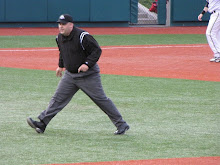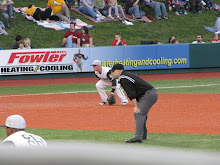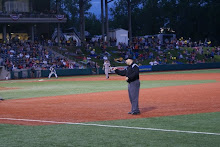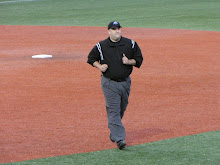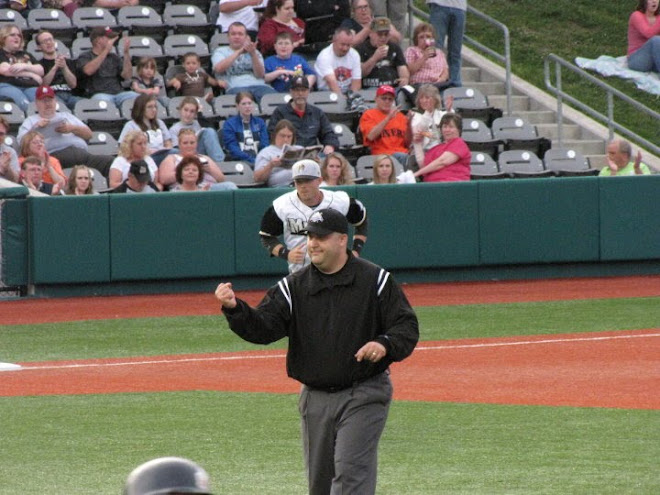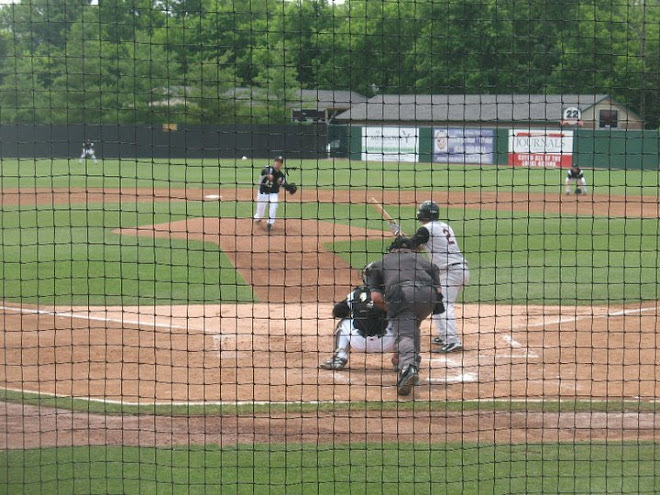
Tonight I get back on the field with two younger games. I have a Boys 11 behind the plate and a Boys 12 in the field. I also get a chance to work with one of our younger umpires which I always enjoy.
Should be another great night at the ball fields.
Tuesday, April 12, 2011

Friday, April 8, 2011
Rules Question
This play happened on a boys 13 game I was watching last night.
Bases empty, one out. Batter hits a gapper in right center field. As he is rounding first, the first baseman is caught watching the ball and is right in the way of the runner. They run into each other. The runner doesn't fall down but he looses his balance and almost comes to a stop. He gets going again, rounds second and is thrown out at a close play at third. The Umpire, who was signaling obstruction, called him out.
Was he right?
I heard the argument and will give you my opinion in a little bit.
Bases empty, one out. Batter hits a gapper in right center field. As he is rounding first, the first baseman is caught watching the ball and is right in the way of the runner. They run into each other. The runner doesn't fall down but he looses his balance and almost comes to a stop. He gets going again, rounds second and is thrown out at a close play at third. The Umpire, who was signaling obstruction, called him out.
Was he right?
I heard the argument and will give you my opinion in a little bit.
Thursday, April 7, 2011
Distance or Angle
Whenever I work with younger umpires, I always ask them this question, what's more important, angle or distance? Never fails, most of them automatically say distance. I then go into about a 10 minute discussion about why you couldn't be more wrong.
When umpiring, angle is the most important thing to making the correct calls. Distance is important also, but only to a point. I have had coaches that have complained that I was not right "on top" of the play. They want me to be about two feet away watching the tag at second. Well, if there is one thing I have learned from umpire school and all the games I have done, it's that being too close can hurt you. Let me give you a few examples.
Example #1:
Bases empty. Play at first. I watch the foot and listen for the catch but I tend to stay far enough back so I can use my peripheral vision to help me see when the ball gets there. If you are right on top of the play, you can't do that. Plus if you have a weird play where the throw pulls the runner off of the bag and you then have to look for a tag, well being too close makes it very hard to see that play.
Example # 2:
Runner on second steals third. You are in the C slot (to the right of the pitcher if you are behind him). If you care about distance you are going to run directly to third. This will put you in a position behind the runner. How can you possibly see the tag? If angle is what you are looking for, you are going to move to the 45 ft line of the third baseline and get the correct angle to see the tag.
Example # 3:
Runner on second, ground ball to second, who throws to first. You sprint over to first to get about 3 feet away to make the call. The runner going to third is really slow (I have seen this happen) and the first baseman fires a throw over the third. Assuming your plate umpire isn't helping you out, how are you going to make that call.
These are just three examples of how being right "on top" of a play can actually put you at a disadvantage.
One thing I truly believe. If you have the right angle and a decent set of eyes, distance should matter at all. Obviously, you want to move towards the play you are calling but if you don't have to get 3 feet away from the play either. Angle is one of the most essential components to being a good field umpire.
One very important thing to understand, most likely, in youth baseball you will never have more than two umpires on a game. Actually, all through high school you will most likely only have two umpires on game. In a two umpire crew, it is impossible to get in perfect position for every call...especially when the kids start throwing the ball all over the place. You need to remember that even though you might not be able to get the desired distance you are comfortable with, it is much easier to get into a position that gives you a decent angle on the call. And even if you get caught out of position, hustle. Do as much as you can to get into position and the coaches that know anything will give you the benefit of the doubt.
When umpiring, angle is the most important thing to making the correct calls. Distance is important also, but only to a point. I have had coaches that have complained that I was not right "on top" of the play. They want me to be about two feet away watching the tag at second. Well, if there is one thing I have learned from umpire school and all the games I have done, it's that being too close can hurt you. Let me give you a few examples.
Example #1:
Bases empty. Play at first. I watch the foot and listen for the catch but I tend to stay far enough back so I can use my peripheral vision to help me see when the ball gets there. If you are right on top of the play, you can't do that. Plus if you have a weird play where the throw pulls the runner off of the bag and you then have to look for a tag, well being too close makes it very hard to see that play.
Example # 2:
Runner on second steals third. You are in the C slot (to the right of the pitcher if you are behind him). If you care about distance you are going to run directly to third. This will put you in a position behind the runner. How can you possibly see the tag? If angle is what you are looking for, you are going to move to the 45 ft line of the third baseline and get the correct angle to see the tag.
Example # 3:
Runner on second, ground ball to second, who throws to first. You sprint over to first to get about 3 feet away to make the call. The runner going to third is really slow (I have seen this happen) and the first baseman fires a throw over the third. Assuming your plate umpire isn't helping you out, how are you going to make that call.
These are just three examples of how being right "on top" of a play can actually put you at a disadvantage.
One thing I truly believe. If you have the right angle and a decent set of eyes, distance should matter at all. Obviously, you want to move towards the play you are calling but if you don't have to get 3 feet away from the play either. Angle is one of the most essential components to being a good field umpire.
One very important thing to understand, most likely, in youth baseball you will never have more than two umpires on a game. Actually, all through high school you will most likely only have two umpires on game. In a two umpire crew, it is impossible to get in perfect position for every call...especially when the kids start throwing the ball all over the place. You need to remember that even though you might not be able to get the desired distance you are comfortable with, it is much easier to get into a position that gives you a decent angle on the call. And even if you get caught out of position, hustle. Do as much as you can to get into position and the coaches that know anything will give you the benefit of the doubt.
Perfect Night for Baseball
Last night was a perfect night to be at the ball fields. Couldn't ask for better weather.
I had two boys 14 games last night and like I mentioned in an earlier post, I umpired with a fellow Umpire School Graduate so that was a plus as well.
I had the plate my first game. The pitchers were around the plate and the catchers blocked almost everything. I felt like I called a very good game. I felt very comfortable back there last night and I think my zone was pretty much rule book. It's always a good feeling to call a good game behind the plate. I punched out a bunch again. I guess the kids aren't ready to swing yet.
The second game was in the field and thank goodness the weather was good because for the second game in a row on the field, I had nothing to do. I have yet to have a close play in the field this year. The only time I did more than signal a call was when I called a balk. Other than that, none of the calls were close enough to justify doing anything more than make that hand signal. That is kind of frustrating.
We did; however, have our first complainer of the year. The assistant coaches on one of the teams was a little intense. He was pacing outside of the dugout before the game even started. I wanted to go over an remind him that stress can cause some serious health issues. He didn't have anything to say to me but anytime a close pitch went against his team, he would throw his hands up. Now, I must say, my partner called a very good game but this guy, I can already tell, is going to cause issues during the year. He never got loud enough for us to say anything but I am sure that will change as the season goes on.
Anyways, I am supposed to have two more tonight if the rains holds off. Can't wait to get back out there.
I had two boys 14 games last night and like I mentioned in an earlier post, I umpired with a fellow Umpire School Graduate so that was a plus as well.
I had the plate my first game. The pitchers were around the plate and the catchers blocked almost everything. I felt like I called a very good game. I felt very comfortable back there last night and I think my zone was pretty much rule book. It's always a good feeling to call a good game behind the plate. I punched out a bunch again. I guess the kids aren't ready to swing yet.
The second game was in the field and thank goodness the weather was good because for the second game in a row on the field, I had nothing to do. I have yet to have a close play in the field this year. The only time I did more than signal a call was when I called a balk. Other than that, none of the calls were close enough to justify doing anything more than make that hand signal. That is kind of frustrating.
We did; however, have our first complainer of the year. The assistant coaches on one of the teams was a little intense. He was pacing outside of the dugout before the game even started. I wanted to go over an remind him that stress can cause some serious health issues. He didn't have anything to say to me but anytime a close pitch went against his team, he would throw his hands up. Now, I must say, my partner called a very good game but this guy, I can already tell, is going to cause issues during the year. He never got loud enough for us to say anything but I am sure that will change as the season goes on.
Anyways, I am supposed to have two more tonight if the rains holds off. Can't wait to get back out there.
Wednesday, April 6, 2011
Is it Infield Fly
Here is a rules question that I use on my rookies every year.
1 out, runners on first and second. Batter hits a high fly ball to short left field (we will say about 20 feet outside the infield). The shortstop is camped under it but for some reason the left fielder calls him off and makes the catch. Whats the call?
1 out, runners on first and second. Batter hits a high fly ball to short left field (we will say about 20 feet outside the infield). The shortstop is camped under it but for some reason the left fielder calls him off and makes the catch. Whats the call?
Tonight should be fun
Oh my!!! I can not wait to get to the fields tonight. It is going to be in the 70s with a slight breeze and, I will be umpiring with a fellow Harry Wendelstedt Umpire School Graduate. It will be nice to be able to work a game...pro style. I have two boys 14 games. Both are part of the wood bat league. It should be an interesting night of baseball.
On a side note, one of the coaches absolutely hates me. He thinks that I am the worst umpire in the world. In all fairness, he has had some wacky plays occur while I have been working his games but the icing on the cake was last year, I tossed him for arguing balls and strikes from the dugout. Now, before you assume I baited him, I warned him four times before I ejected him so I think he had enough opportunities to knock it off. I won't be looking for any trouble but there is a good chance I will have a good story for tomorrow.
On a side note, one of the coaches absolutely hates me. He thinks that I am the worst umpire in the world. In all fairness, he has had some wacky plays occur while I have been working his games but the icing on the cake was last year, I tossed him for arguing balls and strikes from the dugout. Now, before you assume I baited him, I warned him four times before I ejected him so I think he had enough opportunities to knock it off. I won't be looking for any trouble but there is a good chance I will have a good story for tomorrow.
Monday, April 4, 2011
A Reminder about Timing
This weekend, I help run a training session at my local ballfields for all our rookie umpires. In this session, we had the umpires take turns working a practice game. They got a half inning behind the field and then they moved out to the field. For 14 and 15 year olds working a pretty good 12 year old game, they did pretty good but I did have one play that came up that I wanted to discuss.
I wish I would have been video taping this because it would be a great training tool. With no runners on, a ground ball was hit to the shortstop. The throw took the fielder off the bag, but the fielder recovered themselves in time to step on the bag for the out. The umpire, signaled out right when the first basemen caught the ball, then realized they were off the bag and signaled safe and then had to signal out when the play was actually completed. Everyone had a good laugh when it happened but if this had been a real game, that kid would have gotten an earful.
Timing is important in every call you make. It keeps you from making mistakes like that. Remember as an umpire, there is no rush, nothing can happen until you make the call so take a second and think before you act. I always tell everyone to see the play, think the call in your head and then make the call.
There are two main reasons timing helps. First, it helps prevent you from making mistakes like the one descriped above. Secondly, it allows everyone the time to look from the play to the umpire to see that call. Think about it, on close plays, the eyes will be on the play and then you about a second later. By having the correct timing, you will allow everyone to see the call.
Hopefully, this little tip will help you as you get out there.
I wish I would have been video taping this because it would be a great training tool. With no runners on, a ground ball was hit to the shortstop. The throw took the fielder off the bag, but the fielder recovered themselves in time to step on the bag for the out. The umpire, signaled out right when the first basemen caught the ball, then realized they were off the bag and signaled safe and then had to signal out when the play was actually completed. Everyone had a good laugh when it happened but if this had been a real game, that kid would have gotten an earful.
Timing is important in every call you make. It keeps you from making mistakes like that. Remember as an umpire, there is no rush, nothing can happen until you make the call so take a second and think before you act. I always tell everyone to see the play, think the call in your head and then make the call.
There are two main reasons timing helps. First, it helps prevent you from making mistakes like the one descriped above. Secondly, it allows everyone the time to look from the play to the umpire to see that call. Think about it, on close plays, the eyes will be on the play and then you about a second later. By having the correct timing, you will allow everyone to see the call.
Hopefully, this little tip will help you as you get out there.
Subscribe to:
Posts (Atom)